
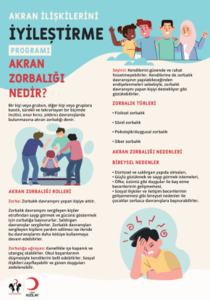
Audience: Parents/Caregivers , Children/adolescents (as potential victims, perpetrators, or bystanders—descriptions focus on children’s behaviours and experiences) , Wider community/authorities involved in reporting and response (police/prosecutor’s office, helpline, digital safety resources)
A seminar brochure explaining peer bullying (roles, types, causes, effects), how to distinguish bullying from jokes/conflict, warning signs, and steps for schools/families including cyberbullying reporting.
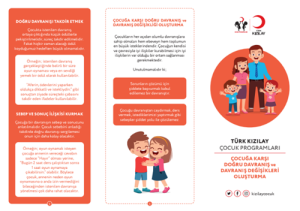
Audience: Parents/Caregivers , Children (indirect—examples show the child’s thoughts/learning from adult responses) , Practitioners who guide parents (e.g., child programme staff/community facilitators), and the wider community
A Turkish Red Crescent brochure guiding parents to build children’s positive behaviour through non-violent responses, clear explanations, small rewards, and adult role-modelling using simple parent–child examples.
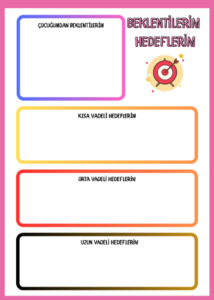
Audience: Individuals seeking personal or family-related goals , Support systems like family, friends, or mentors who may be helping with goal-setting or providing guidance , Broader audience such as community groups, counselors, or any external supporters
This document outlines personal expectations and goals in the short, medium, and long term, with a focus on expectations related to family and children.
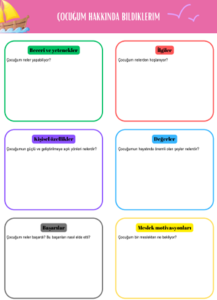
Audience: Parents/Caregivers , Career counselors, teachers, facilitators , Adolescents/children (indirect beneficiaries)
A parent-focused worksheet prompting reflection on a child’s skills, interests, values, achievements, personality traits, and career motivations to support informed educational and career guidance.
Audience: Individuals experiencing violence (especially intimate partner violence survivors) , Individuals unsure whether their experience qualifies as violence , General public/community members
Social media carousel explaining that violence is not only physical, listing different types of violence, and directing survivors to national hotlines for support.
Audience: Individuals supporting a survivor of violence (friends, family, peers) , GBV survivors themselves , Community members and the general public
Social media carousel providing practical guidance on how to support someone who has experienced violence, including emotional support, respecting choices, and referral to emergency and legal services
Audience: Survivors of gender-based violence (GBV), particularly Arabic-speaking individuals in Turkey. , Friends, family members, or caregivers supporting survivors , Broader migrant/refugee communities and service providers raising awareness about GBV response pathways
A social media caraousel post informing GBV survivors about emergency support, medical care, emotional assistance, legal counseling, and national hotline numbers in Turkey.
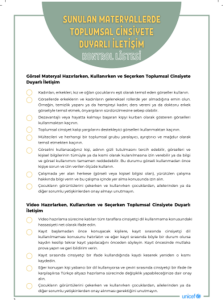
Audience: Community leaders , Trainers, facilitators, educators, and institutional communication teams , Broader institutions (public sector, CSOs, media organizations)
A practical checklist guiding visual, video, and event communication to ensure gender-sensitive, non-stereotypical, and ethical representation, including consent procedures and inclusive participation principles.
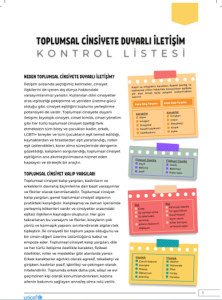
Audience: Individuals, especially those working in communication, education, or social work, who directly influence or engage with others and wish to promote gender equality through their language and behavior , Educators, social workers, and professionals , Community members, policymakers, and activists
This material provides a checklist for gender-sensitive communication, offering guidance on how to use inclusive language to challenge gender stereotypes and promote gender equality in everyday interactions.
Audience: Adolescents , Educators, facilitators, and youth leaders , Parents and community members
This is an educational toolkit that features an interactive game that involves tasks and scenarios aimed at promoting gender equality, respectful communication, and critical thinking through group collaboration and creative activities.